
Large language models (LLMs) can explain complex information in natural language, but may generate unsupported responses without evidence constraints. Cardiac computed tomography (CT) provides high-resolution three-dimensional images, but its results often include specialized terminology, segmentation masks, and quantitative measurements that are difficult for general users to understand. This study proposes a retrieval-augmented cardiac CT health consultation system that uses structured facts from image analysis as evidence for LLM responses. The system segments the myocardium, aortic valve, and aortic valve calcification, then computes structural volumes, spatial ranges, and calcification statistics from the masks and CT intensity values. During consultation, relevant facts are retrieved based on the user's question, and a small curated knowledge base is additionally searched via TF-IDF retrieval to explain medical terminology without overriding the case facts. When facts are insufficient, the system states that the requested information cannot be determined, reducing unsupported speculation and improving traceability. Experiments used 100 cardiac CT volumes from Cheng Hsin General Hospital, achieving Dice scores of 0.9303 and 0.7078 for myocardium and aortic valve segmentation; question-answering evaluation showed that structured facts with LoRA fine-tuning improved evidence use and refusal behavior.
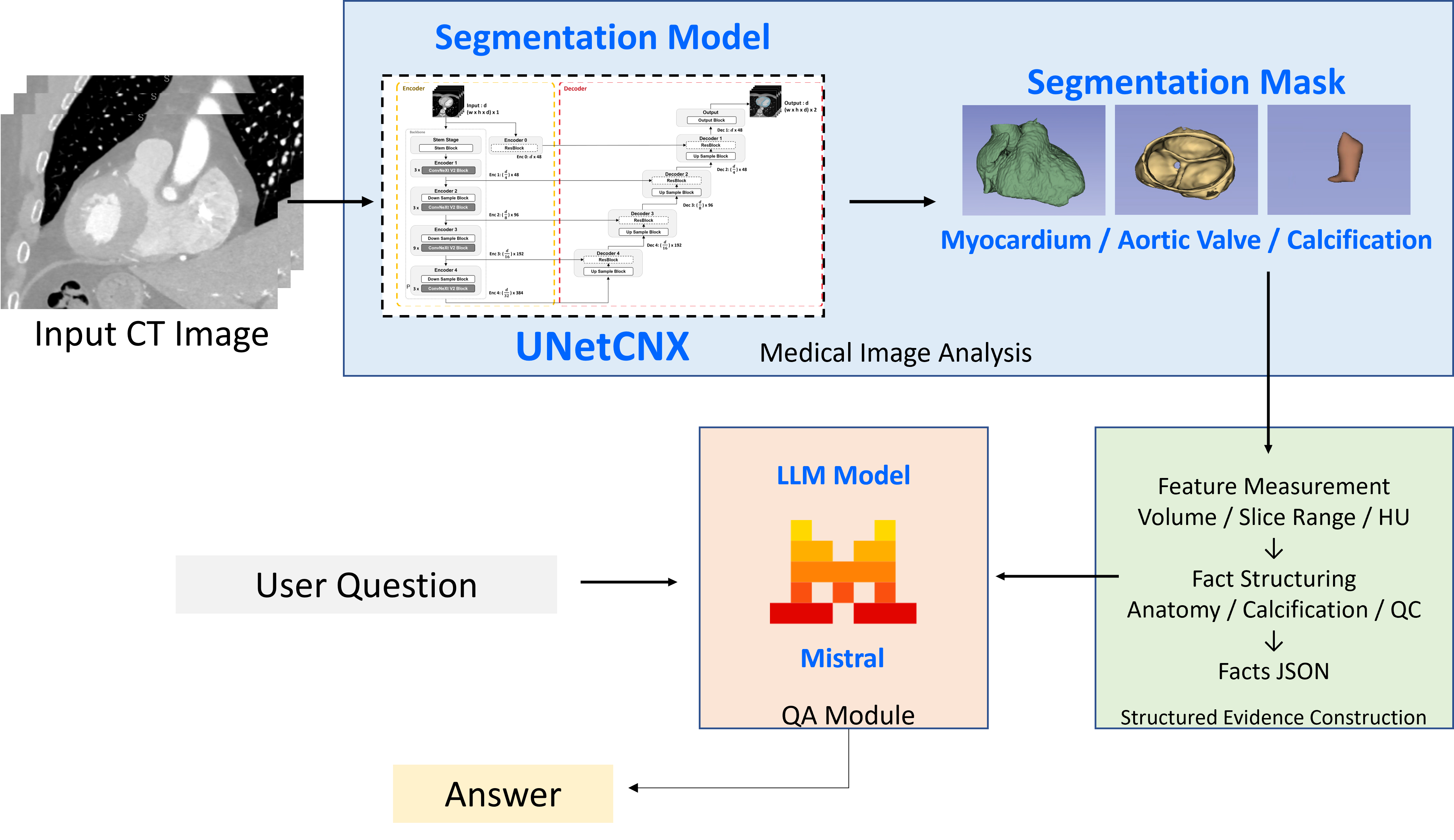
The video below walks through the full consultation workflow: uploading a cardiac CT scan, automatic segmentation of the myocardium, aortic valve, and aortic valve calcification, and an interactive question-and-answer session in which the system retrieves structured image facts and knowledge-base entries to generate grounded, traceable answers.